



Many brands approach GEO (Generative Engine Optimization) the same way they approach SEO: trying to cover as many queries as possible, climb the SERP rankings, and drive more visibility and traffic.
That’s the wrong approach. In SEO, monthly search volume is your first filter. You know how often a keyword gets typed into Google, and you prioritize accordingly. In GEO, that metric doesn’t exist in any reliable form. A handful of tools offer estimated volumes for conversational prompts, but the data is still too rough to anchor a serious strategy around.
In GEO, defining your strategic prompts is the equivalent of keyword research in SEO — but the method is flipped. You don’t start with volume. You start with the user: their intentions, their needs, the questions they actually ask an AI at each stage of their journey.
So instead of asking “which prompt gets the most volume?”, the right question is: “what is my target customer actually asking, and can I answer it better than anyone else?” Simple in theory — but in practice, it calls for a concrete methodology.
This guide walks you through the steps and best practices for identifying and selecting the most relevant prompts for your brand.
What Is a Strategic Prompt in a GEO Context?
In traditional SEO, you work with keywords. In GEO, the right unit of work is the conversational prompt: a question or request phrased in natural language, the way a real user would actually type it into an AI.
It’s not the same thing as a keyword.
- A keyword is “accounting software SMB.”
- A conversational prompt is “what accounting software should I choose for a small business with fewer than 20 employees and no dedicated CFO?”
The difference is fundamental. A prompt carries intent, context, and often a specific situation.
A strategic prompt is one that:
- corresponds to a question your target customers genuinely ask at a key moment in their journey,
- touches on a topic where your brand has real authority to answer,
- triggers a web search by the AI — and therefore a response that cites brands,
- does not mention your brand by name.
Some prompts generate purely factual responses where no brand is cited. Others are more specific, trigger a web search, and create a genuine opportunity for visibility. Those are the ones worth focusing on.
Why Prompt Quality Beats Prompt Volume
In GEO, chasing volume is a dead end — for three concrete reasons.
- AIs don’t “partially” cite every source. They select 3 to 5 sources per response, sometimes fewer. Being present in an AI response is binary: you’re either there or you’re not.
- Trying to cover everything dilutes your topical authority. Language models assess a source’s credibility based on the consistency and depth of its content on a given subject. A site that superficially touches on 200 topics will never be seen as an authority on any of them.
- Response quality always wins. A page that answers a specific prompt precisely and clearly has a far better chance of being cited — and of earning a brand mention — than a generic page that skims ten topics at once.
The real GEO strategy is to become the best available answer for a defined set of strategic questions.
How to Identify Strategic Prompts for Your Brand
Here’s a five-step methodology that works regardless of company size or industry.
1. Start From Your Personas’ Real Intentions — Not Your Product Catalog
The classic mistake is building your prompt list around what you sell rather than what your customers are trying to solve.
Your personas have problems, doubts, and open questions. That’s where you need to dig.
For each persona, ask yourself:
- What are the 3 moments in their journey where they might turn to an AI for an answer or solution?
- Based on the persona’s profile (age, needs, situation…), what topics might those questions cover?
- How would they naturally phrase it — in their own words?
- What level of information are they looking for: understanding a concept, comparing options, making a decision, solving a technical problem?
A marketing director looking for a content marketing solution isn’t going to ask ChatGPT “content marketing.” They’re going to ask “how do I measure the ROI of a sponsored content strategy in B2B?” or “what tools are available for link building with a $2,000/month budget and some hands-on support?”
That’s the level of granularity you need to work at.
2. Tap Into Your Ground-Level Intelligence
You already have a goldmine at your disposal: the real questions your prospects and customers ask.
Sources to mine systematically:
- Questions fielded by your sales and support teams (what customers ask before buying, and after)
- Searches on your internal site search (if your site has one)
- Customer reviews and product comments (spontaneous phrasing is invaluable)
- Forums, Reddit, LinkedIn, and industry communities (pay attention to how people frame their problems)
- Google’s “People Also Ask” boxes and search suggestions (reliable indicators of real questions)
- Specialized tools like AnswerThePublic, AlsoAsked, or the semantic research modules in SEMrush and Ahrefs
The goal isn’t to collect 500 questions. It’s to identify the 20 to 30 recurring questions that account for the majority of your audience’s informational needs.
3. Qualify Each Prompt Against 4 Criteria
Once you have your raw list, run it through a four-part filter:
Relevance to your brand. Do you have genuine authority to answer this question? Is it a topic where you can offer something differentiated — not just repeat what everyone else is saying?
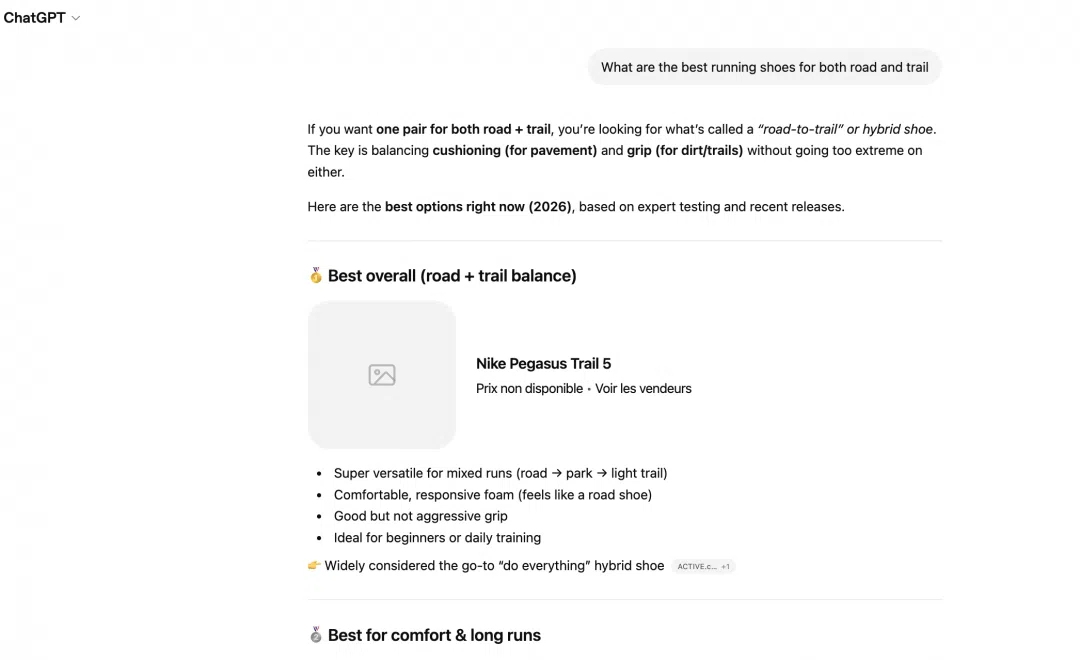
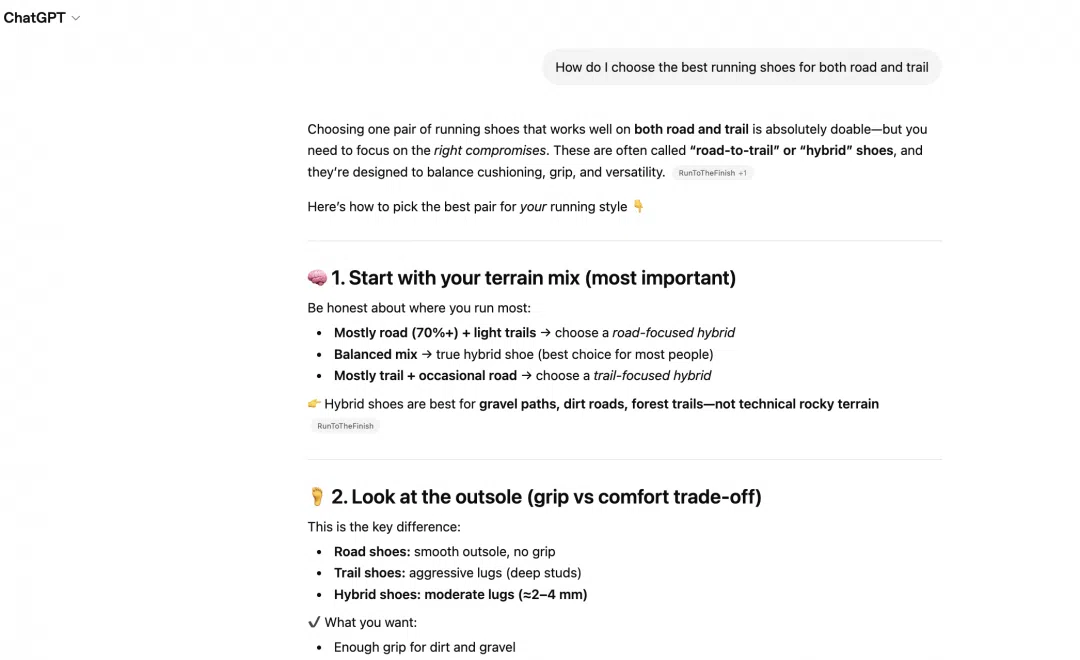
Does the prompt trigger a web search and brand mentions? Does the prompt trigger a web search and brand mentions? This is the most important filter. Test the prompt in ChatGPT or Perplexity: does the response cite brands, tools, or service providers? If yes, you’re looking at the right type of prompt. If the response is purely explanatory or factual with no brand mentions, move on — that prompt won’t generate any commercial visibility for you. Comparison, recommendation, and purchase-decision prompts are the most valuable. Purely informational prompts like “how does it work” or “what is X” should be treated carefully: they can help build topical authority, but they rarely drive direct brand visibility.
The prompt doesn’t include your brand name. Branded prompts optimize your presence for people who already know you. That’s not without value — but it’s not the real GEO opportunity. Focus on non-branded prompts where you can show up in front of prospects who don’t know you yet, and where your competitors are already present.
Competitive landscape in AI responses. Who’s already being cited on this prompt? While the most attractive targets are prompts where you spot a competitive gap, if the responses are dominated by highly established players (major institutions, multinationals…), look for a more specific variant where you have a real opening.
4. Group Prompts Into Strategic Themes
Once you’ve qualified your prompts, don’t treat them as a flat list. Group them by themes — broad subject areas where you want your brand to become the go-to reference.
Rather than tackling each prompt in isolation, you build a coherent presence across an entire topic area by covering multiple complementary intents around the same subject.
A concrete example: an HR management SaaS platform might define three strategic themes:
- HR digitalization for SMBs: prompts like “what HR software for a 50-person company?”, “how do I automate payroll for a small business?”, “what HR tools can replace Excel?”
- Compliance and legal obligations: “how do I manage mandatory annual performance reviews?”, “what tool tracks PTO balances in real time?”
- Comparison and solution selection: “what’s a good alternative to Lucca for an SMB?”, “best HRIS for a two-person HR team?”
Each theme becomes a territory to develop in depth: structured on-site content built around its constituent intents, plus an off-site presence across media that cover those topics. AI models recognize a coherent, specialized source that consistently returns to the same subjects — and that’s exactly what drives visibility in terms of citations and brand mentions.
In practice, a brand can start with 3 to 5 strategic themes, each grouping 5 to 10 qualified prompts. That’s a manageable scope for building real topical authority without spreading yourself too thin.
5. Test, Observe, Iterate
Unlike SEO, where rankings are measurable almost automatically, GEO still requires more hands-on tracking in most cases.
A simple approach:
- Build a list of 20 to 40 priority strategic prompts
- Test them regularly in private/ephemeral chat mode (no history) across the main AI engines
- Note who gets cited, in what position, and how they’re described
- Track your presence over time
This regular tracking helps you spot opportunities (prompts where you should be cited but aren’t) and gaps in your content strategy.
Once You’ve Identified Your Prompts: How to Create the Right Content
Identifying and mapping your strategic prompts is the starting point. The next step is producing the on-site content that will get you cited by AI — with the right structure, the right format, and the right credibility signals.
That topic deserves its own deep dive: how to align each page with a conversational intent, how to write for language models without sacrificing readability, and which E-E-A-T signals to prioritize. All of that is covered in our dedicated guide: The Best Content Strategy for Visibility in ChatGPT Search and AI Engines.
FAQ: Strategic Prompts and AI Visibility
What’s the difference between an SEO keyword and a GEO prompt?
An SEO keyword is a fragment of language optimized for a ranking algorithm. A GEO prompt is a complete, natural-language question that reflects a real user need. In GEO, you’re not trying to rank for “HR software SMB” — you’re trying to be the best answer to “what HR software should I choose for a small business without a full-time HR director?” The logic shifts from keyword density to answer relevance.
How many strategic prompts should you target?
There’s no universal number, but 20 to 50 prompts is a reasonable starting point for most brands. The goal isn’t quantity — it’s identifying the prompts where you have genuine authority and a competitive edge to build. Better to be the go-to cited source on 15 strategic prompts than to be absent from 200 generic ones.
Are high-volume prompts the most valuable in GEO?
The question looks different in GEO: unlike SEO, there’s no reliable volume data for conversational prompts yet. The few tools that offer estimates produce numbers too rough to use as a serious prioritization criterion. In GEO, you don’t prioritize by volume — you prioritize by value: does this prompt correspond to a decisive moment in your customer’s journey? Do you have real authority to answer it? Does the AI response cite brands? Highly specific prompts — “which [product/service] should I choose for [specific context]?” — are often more strategically valuable than broad generic topics, precisely because competition is lower and your answer’s relevance is more apparent.
How do I know if my content is ranking well in AI responses?
The most reliable method is still manual testing in private chat mode: run your target prompts through ChatGPT, Perplexity, and Gemini, note the sources cited, and keep a tracking log. To scale this process, tools like Profound or Authoritas offer automated monitoring. An AI visibility analysis — like the one offered by Getfluence — can also give you a structured view of your positioning and your competitors’ across your strategic prompts.
Should I create new content or optimize what I already have?
Both. Start by auditing your existing content against your priority strategic prompts: some pieces can be restructured, enriched, or updated to better address the conversational intents you’ve identified. That’s usually faster and cheaper than starting from scratch. Then identify uncovered prompts and produce the missing content, prioritizing the formats that perform best in GEO: comprehensive guides, structured comparisons, and thematic FAQs.
Conclusion
GEO is a young discipline, but one rule is already clear: precision beats volume.
The brands that win visibility in AI responses won’t be the ones that produced the most content or targeted the most queries. They’ll be the ones that took the time to identify their personas’ real questions, answer them better than anyone else, and build a coherent presence across a well-defined topical territory.
The right strategic prompt is one that corresponds to a real moment in your target customer’s life — not a cell in your keyword spreadsheet.
That’s where your visibility in the conversational search era begins — and where it’s won.
Want to identify the priority strategic prompts for your brand and find out which sources AI engines are citing in your market? Reach out to request your AI visibility analysis.