
How podcasts can boost your marketing strategy and why you should use them
Podcasts now reach 619 million listeners worldwide and record highs in the US. Here is why they work for marketing and how to use them, from guest spots to sponsored content.

Summary
Podcasts: a proven channel for marketers and advertisers
Podcasts have become a regular part of the digital marketing mix.
This form of content has been around for a while, with roots in the audio blogs of the early 2000s, but it really caught marketers' attention once its audience became large and loyal.
That audience keeps growing. According to an eMarketer forecast reported by Search Engine Land, there were 584.1 million podcast listeners worldwide in 2025, a number expected to reach 619.2 million in 2026 and 651.7 million in 2027.
In the US, The Infinite Dial 2026 by Edison Research shows all-time highs: 80% of Americans aged 12 and over have ever listened to or watched a podcast, 58% (about 167 million people) did so in the last month, and 45% (about 130 million) in the last week.
This steady demand has led marketers and advertisers to include this engaging form of content in their strategies.
But why should you include podcasts in your marketing strategy?
At Getfluence, we selected recent stats and information to keep you updated on the podcast market and on what your business can get from it.

Here's all you need to know.
The benefits of using podcasts in your marketing strategy: what the numbers say
Behind the growth of the podcast market are the concrete benefits this format offers to businesses.
From a loyal audience to a reasonable production cost, there are good reasons to include a podcast in your marketing strategy.
But is it really worth it?
Here are the main ways in which podcasts can benefit your marketing strategy:
They can be listened to while multitasking
People find time for their favorite podcasts in the middle of other activities.
The format makes it possible to follow content every day while commuting, working out or doing household chores.
The car is a good example. According to Infinite Dial 2026 figures reported by Radio Ink, 37% of US drivers and riders listened to podcasts in the car in the past month, and 55% of those aged 18 to 34.
The smartphone remains the main device: among US weekly listeners, 67% listen mostly on a phone, according to a Cumulus Media survey cited by Search Engine Land. Podcasts fit busy routines and let you reach your target audience on a regular basis.

They help you reach your target audience
Whether you partner with a podcast producer or start your own podcast, you can expand your reach.
One of the main advantages of podcasts is that they are organized by topic, so they are found by people who are likely to be interested in what you offer.
This way, your business can create content that appeals to its target audience and use it to reach more people in that niche.
They are less expensive and time-consuming than videos
An audio podcast is easier to produce than a polished video.
Podcasts usually require less time, money and staff than other content formats.
A good-quality microphone, headphones and the right producer are enough to record an audio episode, while a high-quality video often requires a larger upfront budget. Many shows now also film their recordings, which adds a video version without changing the core format.
When done right, podcasts can therefore promote your business with a good return on investment.
They have a positive influence on your SEO game
Your website's SEO can also benefit from podcasts.
Why?
There are several reasons.
First, each episode can have its own page with show notes and a full transcript.
This text can be indexed by search engines and read by AI assistants, which gives your expertise more chances to appear in search results and in AI-generated answers.
In addition, appearing as a guest on a podcast can help you earn backlinks pointing toward your website.
For instance, the website hosting the podcast often links to its guests' websites from the episode page.
The guests, and sometimes their listeners, then share the episode on social media, which extends its reach.
The result is that you can build backlinks and brand mentions either by creating your own podcast or by being a guest on other shows.
They offer a large variety of formats
Podcasts offer a wide variety of options.
This lets you keep your audience engaged over long periods, with different kinds of content they can enjoy without getting bored.
Here are some of the most popular podcast formats:
- The interview
The "interview" format features a host and a guest.
The guest brings their own experience and expertise, which gives listeners interesting and engaging content.

- The co-hosted or "conversational" format
Co-hosted podcasts differ from interviews as they feature two hosts who talk together, much as they would in a normal conversation.
Usually, each host has a different role.
For instance, one of them may present the news, while the other adds playful or satirical commentary. - The solo/monologue
The solo or monologue is among the most common forms of podcasts.
It is often chosen for its low setup requirements, as it only takes one speaker and decent audio equipment. - The panel
The panel format is similar to the interview, but it features more than one guest.
Listeners feel like they are part of a real conversation between people who know the subject. - Real-life stories
Real-life stories tell events or stories from around the world.
You can pick inspiring stories you want your brand to be associated with, and use them to leave a lasting memory in the minds of your listeners. - Fictional stories
The biggest benefit of fictional stories is that you can shape them entirely around what your business needs.
Build a story that reflects your brand's values, or have a producer write it for you.
It takes a good storyteller and serious preparation, but the results can be worth the effort.
How to implement podcasts in your marketing strategy
There are several ways to include podcasts in your marketing strategy.
You can combine several elements to find what fits your needs: the right format, length, tone of voice and producer.
Here are some tips on how to implement podcasts in your marketing strategy:
Collaborate with producers your audience loves
You can create a podcast of your own, but keeping a high-quality show running over time can get expensive and time-consuming.
Instead, you can look for the podcast producers your audience likes most and build a collaboration with them.
This expands your reach and helps you build a genuine connection between your brand and the people you want to reach.
So, how can you build a relationship with your audience that lasts?
This leads to our final tip on how to use podcasts in your marketing strategy…
Use podcasts as a form of sponsored content to improve your brand positioning
One of the biggest strengths of podcasts is that they can be used as a form of sponsored content.
Unlike traditional ads, sponsored content focuses on building a relationship with your customers, by offering them content that associates your brand with its core values.
For instance, your founder can take part in a podcast your audience follows and talk about your brand's values and story.
This goes beyond a simple product mention: it helps shape how the public sees your business.
And the benefits don't end here.
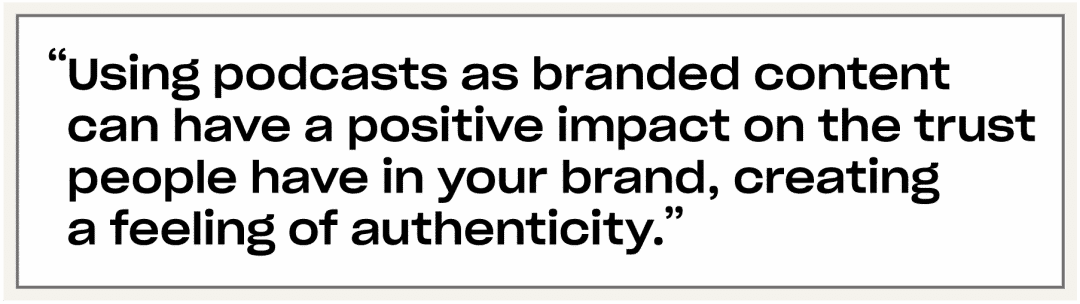
Sponsored podcast content can strengthen the trust people have in your brand, because it feels more authentic than a classic ad.
Your brand positioning benefits from it, and you can create a positive association in your audience's mind that lasts well beyond the episode. Combined with sponsored articles in relevant media, it also multiplies the places where your brand is mentioned, which supports both your SEO and your visibility in AI search.
Learn more about the benefits of sponsored content now with Getfluence.
Most asked questions about podcasts for marketing
What is a podcast?
A podcast is a series of digital audio (and often video) episodes that can be streamed or downloaded from a website, an app or a media player. Podcasts usually follow a theme and feature a host along with one or more guests who have relevant experience on the subject of the episode.
Why do podcasts matter to marketing?
Podcasts reach a large and loyal audience: according to The Infinite Dial 2026, 58% of Americans aged 12 and over listened to or watched a podcast in the last month. They let brands reach people regularly, often while they do other things, and audio episodes are usually less expensive to produce than videos.
How can podcasts be used for marketing?
A good way to use podcasts in a marketing strategy is as sponsored content, to raise awareness among your target audience and strengthen your brand positioning. You can manage your sponsored content campaigns, including sponsored articles in more than 70,000 vetted media, with Getfluence.