
What Is Sponsored Content and How Can It Benefit Your Business?
What sponsored content is, what it is not, and how it helps your business: engagement, brand positioning, reach in search and AI answers, and fewer ignored ads.

Summary
Sponsored content: a proven tool for digital marketers
The internet market keeps evolving.
Accessible and easy-to-use technologies have led to recurrent, quick changes in the way marketers try to reach their audience and pursue their marketing effort.
New platforms and formats appear every year, and AI search engines now answer many questions directly. Through all these changes, sponsored content has stayed one of the most reliable ways for brands to reach people.
It keeps gaining ground because of benefits like higher brand recall, higher engagement and results that outperform traditional ads.
The market is still growing: EMARKETER expects US native display ad spending to grow 13.1% in 2026, to $147.98 billion. For a broader view of the market, see our analysis of the state of the sponsored content market.
So, what is exactly sponsored content and how can it benefit your business?
At Getfluence, we work every day with brands, agencies and media on sponsored content campaigns. Here is what we have learned about how it works and what it can do for you.
Here’s all you need to know:
What exactly is sponsored content

Sponsored content is a form of content promotion in which a brand pays a publisher to distribute content that associates with its values, in order to raise awareness.
Unlike traditional ads, the content promoted with sponsored content is always informative, educational or entertaining.
It generates value for users, instead of just promoting a product or service.
Sponsored content has some key characteristics:
- It can be created by both the media and the brand
The content promoted with sponsored content can be created by specialists hired by the brand itself, or by professionals from the publishers (ex. blog writers).
Sometimes brands also use user-generated content (UGC), thus allowing users themselves to tell the brand’s story and talk about its values from their view-point. - It provides added value to the users
Sponsored content engages users due to its educational, entertaining or informative purpose, thus providing them with added value. - It focuses on the values of a brand, not just its product or services
Sponsored content focuses on building awareness and notoriety about a brand's values.
This can help build a long-term relationship between the customer and the whole brand, instead of just driving their interest toward a single product or service it offers. - It may be shared through multiple formats and channels
Sponsored content is a very flexible concept which incorporates multiple formats and channels.
Some forms of sponsored content include:
- Sponsored articles
- Videos
- Podcasts
- Infographics
- Case studies
- e-Books
- White papers
The content can be then shared through numerous different channels, from media websites and newsletters to social media, apps and the brand’s own website.
The benefits of sponsored content
Behind the increasing popularity of sponsored content lie its numerous benefits.
From higher reach to higher engagement, the perks of this practice are worth a close look.
Here are some of the most relevant ways in which sponsored content can help your businesses in its marketing efforts:
1. It generates engagement
Users connect with sponsored content at a deeper level.
When done right, sponsored content can create an emotional connection with the customer, who may then associate the emotion they feel with your brand.
Not only can this lead to a higher brand recall, it also has a clear positive impact on your customers’ engagement.
Readers choose to read a sponsored article, which is why sponsored content tends to outperform traditional ads on attention and recall.
More recent research points the same way. In Edelman’s 2026 report on trust and brands, 41% of people say what others say about a brand has the biggest effect on their trust, against only 20% who cite what the brand says about itself. An article in an independent media outlet is much closer to the first than any ad.
There’s also a simple explanation behind these results.
When customers interact with sponsored content, they actively choose to do it.
A user may click on a sponsored article because they’re genuinely interested in the title and want to learn more.
Therefore, they’re more likely to engage with the content you promote.
This is a key perk of sponsored content and it’s among the main reasons behind its success.

2. It boosts the positioning of your brand
Instead of just repeating the same slogan over and over, sponsored content allows your brand to tell a story.
This story should represent the values your brand wants to be associated with, and if told well, it can stick in your customers’ minds for weeks, or even months.
This way, sponsored content can create a positive association with such values, which will stay in the minds of your audience for a long time.
3. It helps you reach a large audience
When customers get engaged with a story that appeals to them, they are more likely to share it on their preferred channels.
These may include social media like Instagram, Facebook, LinkedIn or X, but also the old-fashioned word-of-mouth.
All these factors combined result in a higher reach, thus allowing your brand to approach more potential clients.
Sponsored articles also reach people through search. A link from a relevant media site helps your pages rank, and the article itself can show up in AI answers: Google’s AI Overviews reach more than 2.5 billion users a month, and AI engines like ChatGPT often cite third-party media when they recommend brands. Links and brand mentions work together here.
4. It can bypass banner blindness
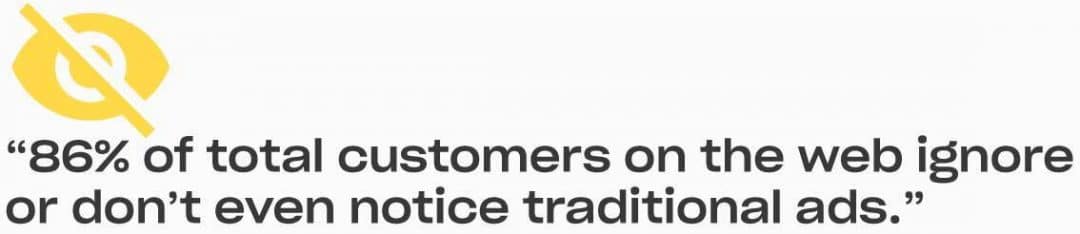
Many web users have learned to ignore display ads, and sponsored content can get around this banner blindness because it sits inside the editorial content.
The problem has not gone away: eyeo’s 2026 ad-blocking report counts about 1.1 billion people using an ad blocker, 30% of all internet users.
This is largely due to a phenomenon called banner blindness, in which web users ignore banner-like information, whether they do it consciously or subconsciously.
For instance, they may actively decide to ignore an ad that is not appealing to them, or they may get used to avoiding areas of a webpage or social media where ads are usually located.
In both cases, sponsored content can help your brand bypass banner blindness thanks to its formats, which help it not to be perceived as an annoying ad in the mind of your customers.
What is NOT sponsored content
Even though sponsored content is now widely used, there’s still some confusion about what it covers.
Here are some practices that are not considered ‘sponsored content’:
- Product placement
Sponsored content differs from product placement because it includes a story.
Traditional product placement consists of paying to have your product or service included in a creative work, like a movie or a TV show.
On the other hand, the whole content used for sponsored content campaigns not only refers to what you offer, but it encompasses your brand values in a narration that is followed by the whole work. - Classic press-releases
Classic press-releases are statements written by a PR professional, which include informative insights about a specific news topic.
They are released by business owners and they focus on informing people about a product or service, rather than just trying to sell it.
Some of them are then picked by journalists who write news using them as a source.
On the contrary, sponsored content does not need to undergo any journalists’ selection, as it is the result of a sponsored partnership between a brand and the media.
Boost your sponsored content campaigns using the right tool
Although sponsored content is a powerful means that can significantly benefit your brand’s marketing strategy, it may not always be easy to implement such practice.
A well-developed sponsored content strategy requires time and effort, and it may get expensive, tedious, and even highly challenging.
Luckily, there are tools that can help you with that and save you time and money.
Getfluence is one of them.
With more than 70,000 vetted media around the world, used by more than 5,000 brands and agencies, it lets you partner with relevant, authoritative websites in your field and reach your potential clients in a simple way.
With Getfluence, you can manage your sponsored content campaigns taking advantage of competitive rates negotiated for you by our experts.
Finally, you can manage your campaigns from one place, with a centralized messaging system to share all the documents and information you need with publishers.
Save your precious time and money by trying Getfluence now.
Most asked questions about sponsored content
What does sponsored content mean?
Sponsored content is a form of content promotion. It consists of a brand paying a publisher to distribute content that associates with its values, in order to raise awareness among consumers and shape its public perception to enhance its brand positioning.
What is an example of sponsored content?
Some examples of sponsored content include sponsored articles, videos, podcasts, infographics and white papers. A well-known case of branded content is Red Bull Stratos, a 2012 event that set the record for the highest human free-fall at the time and enhanced Red Bull world-wide brand positioning.
How can I build an efficient sponsored content strategy?
You can build a functional sponsored content strategy by relying on authoritative publishers and building content that aligns with your brand’s values. Tools like Getfluence help you find suitable media and manage your campaigns, saving time and money.